
Contractor websites built around how homeowners actually decide.
Contractor website design focused on lead generation — not portfolio gloss. Trust signals up front, fast quote response, mobile-first, and local SEO structured to get you into the Google 3-pack for the trades you actually do.
How homeowners actually find and choose contractors.
The job is decided long before the customer fills out a form. Once you understand the four steps below, the design choices for the site stop feeling like opinions and start feeling like math.
-
They Google your trade + their town
"Roof repair Coshocton." "Siding contractor near me." Google Maps shows three results above the fold. Customers tap those three before they scroll.
-
They scan reviews
Star count, recency, and how the owner responds. A profile with 50 reviews from this year beats one with 200 from 2019. Real responses to negative reviews matter as much as the count.
-
They click through to the website
They want to see real work, real license info, and a clear answer to "do you actually do what I need?" If the site looks half-built, they bounce.
-
They send a request — to the contractor who replies first
Whoever responds first usually wins the job. Fast quote response is a bigger lever than almost anything else on the site.
What separates contractor sites that book jobs from ones that don't.
None of these are mysterious. But most contractor sites still miss half of them — usually because they were built by a templated agency that builds the same site for a dentist and a plumber and a wedding photographer.
Phone-prominent header
If a homeowner has a leak, they're not filling out a form. The phone number has to be one tap, top-right, on every page.
Real before/after photos
Stock photos signal 'I'm hiding something.' Real work signals 'I do this every week.' The decision is made in the first scroll.
License + insurance up front
Number, state, expiration. Trust is binary at this stage of the search — the customer either believes you're licensed or moves on.
A page per real service
Roofing. Siding. Gutters. Decks. One page each, structured for local search — not all crammed into a single 'Services' bullet list.
Mobile-first quote forms
Most of these requests come from a phone in the driveway after the customer noticed the problem. The form has to fit one thumb.
Clear service area
Counties, cities, ZIP codes. Vague 'serving the tri-state area' kills conversion — customers want to know if you'll actually drive to them.
Financing or payment options
Roofs, additions, kitchen remodels — five-figure jobs. Even a single line about financing options moves customers from 'maybe later' to 'let's talk.'
Speed: under 2 seconds on mobile
Slow site = bounced lead. Astro builds load in under a second. WordPress contractor templates often take 6+ seconds — every one of those seconds is lost jobs.
How my work translates to contractor businesses.
Straight talk: my recent local work has been in auto detail, barbershop, and event transportation — not contracting. I'm not going to stick a fake contractor case study in front of you.
What I will tell you is that every site I build follows the same conversion principles that work for contractors: phone-prominent headers, real photos, trust signals, fast mobile loads, structured local SEO, and lead capture before the customer leaves the page. The trade changes; the principles don't.
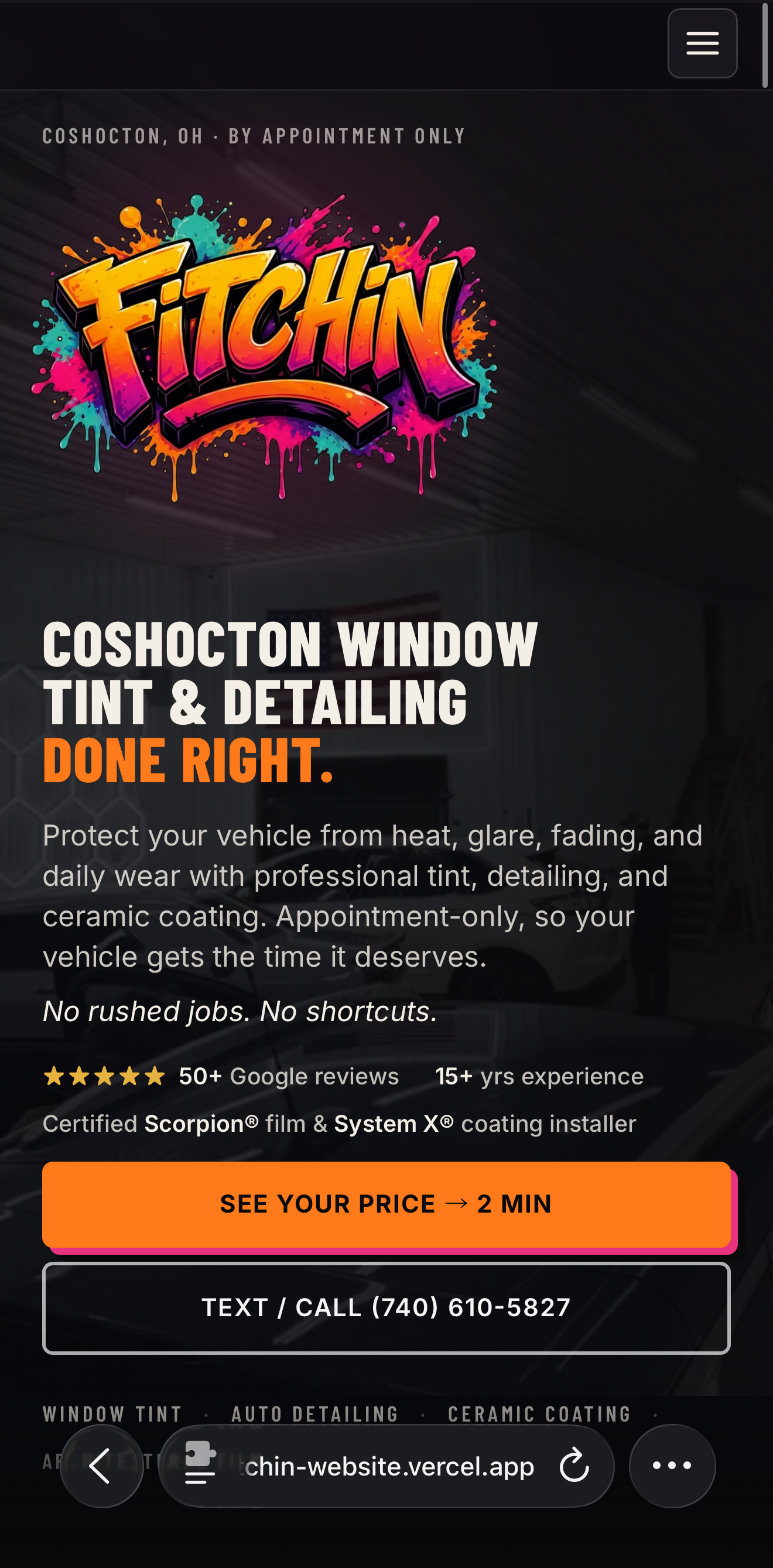
Fitchin Automotive Detailing
A phone-only operation rebuilt as a 378-vehicle quote system that captures every lead. The same conversion principles map directly to a contractor quoting roof replacements or kitchen remodels.

Modern Classic Barbershop
A premium brand built on top of Square + Shopify with custom integrations. Same approach scales to a contractor running estimates through Jobber or Housecall Pro behind a real brand.
Common questions from contractors.
How much does a contractor website cost?
Most contractor builds land between the Starter ($1,500) and Lead Generation ($3,000) packages. If the build needs custom estimate-request logic or integrates with software like Jobber, Buildertrend, or CompanyCam, it moves toward the Custom Lead System tier. The free quote covers what I'd actually scope for your business.
Can the site integrate with my estimating or project-management software?
Most field-service and estimating platforms expose lead-capture APIs or webhook integrations. The site can push qualified estimate requests directly into your existing workflow so the office team isn't double-entering. Specifics depend on the platform — happy to scope this on the call.
I have a Houzz / Angi / GAF profile already — do I still need a website?
Yes — for two reasons. First, those platforms own your reviews, your profile, and your placement. Your site is the only digital asset you actually own. Second, when a homeowner Googles your name (which they do before calling), your real site is what builds trust. The directory profiles are lead sources; the site is the trust check.
You haven't built for contractors — does that matter?
Honest answer: it matters less than it sounds like. The conversion principles — phone-prominent header, real photos, license visible, fast mobile load, structured local SEO — are the same across service trades. I'd rather tell you that up front than fabricate a contractor case study. You can verify the real builds (Fitchin, Modern Classic, All Transport) and decide if the execution chops translate.
Local SEO for contractors.
Most contractor leads come from Google Maps. The work that gets you into the local 3-pack is on-page SEO (titles, schema, service-area pages), Google Business Profile optimization, and a steady review cadence. None of it is fast — but it compounds.
The build covers the on-page foundation. The recurring work — reviews, photos, posts — is something you (or your office manager) can keep running without paying an agency a monthly retainer.
Ready for a contractor site that actually books jobs?
Send me your current site. I'll tell you exactly what I'd rebuild — and what's losing you leads right now.